
ATTENTION: People who want to stop taking antidepressants
FREE YOURSELF FROM UNNECESSARY MEDICATIONS AND SIDE EFFECTS
CALCULATE, MONITOR AND ADJUST YOUR INDIVIDUAL MEDICATION TAPERING PLAN TO AVOID WITHDRAWAL SYMPTOMS AND SAFLEY STOP ANTIDEPRESSANTS WITH THE TAPERMATE APP
Ensure you have support from your prescriber before making any changes to your medications
Ensure you have support from your prescriber before making any changes to your medications
CLICK BELOW TO WATCH FIRST!

Step 1: Complete The Form Below To Estimate Your Risk Of Withdrawal Symptoms When Stopping Your Antidepressant
Next Step: Download the TaperMate App To Start Your Tapering Journey


ATTENTION: People who want to stop taking antidepressants
FREE YOURSELF FROM UNWANTED MEDICINES & SIDE EFFECTS
CALCULATE, MONITOR AND ADJUST YOUR INDIVIDUAL MEDICATION TAPERING PLAN TO AVOID WITHDRAWAL SYMPTOMS AND SAFLEY STOP ANTIDEPRESSANTS WITH THE TAPERMATE APP
CLICK BELOW TO WATCH FIRST!
Ensure you have support from your prescriber before making any changes to your medications
Next Step: Complete The Form Below To Estimate Your Risk For Withdrawal Symptoms
Next Step: Download the TaperMate App To Start Your Tapering Journey
For People Taking Psychotropic Medications Who Want To Safely Stop
(Or at least trial stopping to see how they feel without medication)
For example...
SSRI/SNRI Antidepressants
Tricyclic antidepressants
Benzodiazepines/Z-drugs
Antipsychotics
Mood stabilisers
Opioids
Gabapentinoids
MAOI Antidepressants
Stimulants
For People Taking Psychotropic Medications Who Want To Safely Stop
(Or at least trial stopping to see how they feel without medication)
For example...
SSRI/SNRI Antidepressants
Tricyclic antidepressants
Benzodiazepines/Z-drugs
Antipsychotics
Mood stabilisers
Opioids
Gabapentinoids
MAOI Antidepressants
Stimulants
What We Do

Feature & Benefit
Lorem ipsum dolor sit amet consectetur. Aliquam odio enim pharetra et. Diam varius magna lobortis consequat elit.
Feature & Benefit
Lorem ipsum dolor sit amet consectetur. Aliquam odio enim pharetra et. Diam varius magna lobortis consequat elit.
Feature & Benefit
Lorem ipsum dolor sit amet consectetur. Aliquam odio enim pharetra et. Diam varius magna lobortis consequat elit.
Feature & Benefit
Lorem ipsum dolor sit amet consectetur. Aliquam odio enim pharetra et. Diam varius magna lobortis consequat elit.
Feature & Benefit
Lorem ipsum dolor sit amet consectetur. Aliquam odio enim pharetra et. Diam varius magna lobortis consequat elit.
Feature & Benefit
Lorem ipsum dolor sit amet consectetur. Aliquam odio enim pharetra et. Diam varius magna lobortis consequat elit.
STILL NOT SURE?
Frequently Asked Questions
Here's what we usually get asked
So how does TaperMate work?
The TaperMate App supports you through all stages of your medication taper!
From learning about medication withdrawal and tapering - with useful resources to get you (and your doctor) up to speed before you make the decision to stop your medication.
To planning your taper - select from 5 different tapering methods and enter your unique tapering plan as discussed with your doctor. TaperMate calculates each step for you and shows you HOW to actually make the small doses required, using the medication you have on hand.
To tracking and adjusting your taper - Record and track your dose, symptoms and mood over time to identify patterns and generate reports to share with your doctor so that you can adjust the taper plan as needed, based on your individual response.
What is hyperbolic tapering?
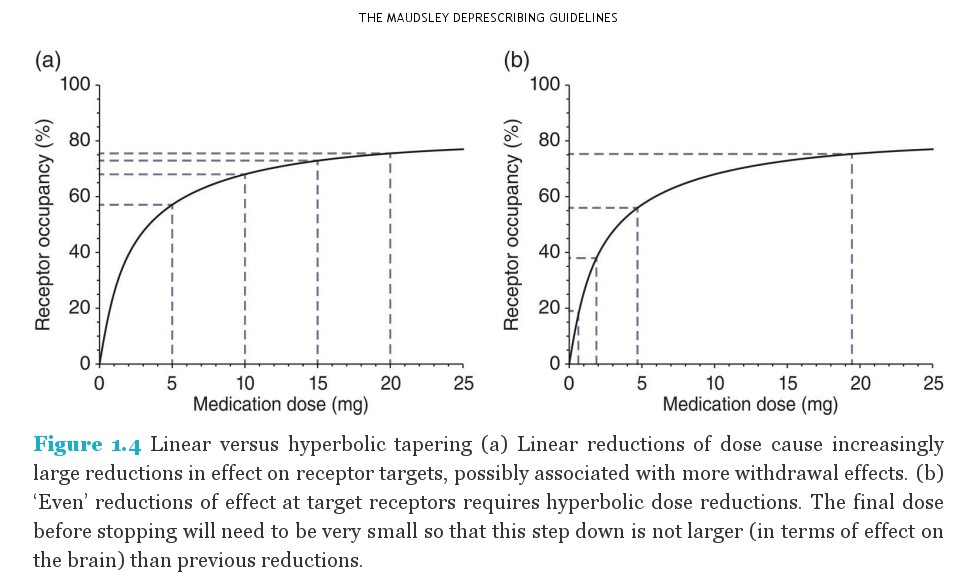
Hyperbolic tapering is the best method for safely and gradually reducing the dose of a psychotropic medication to avoid severe withdrawal or 'discontinuation' symptoms. It involves reducing the dose by smaller and smaller amounts over time. Lay people have been using similar methods for decades, reducing by a small percentage (e.g. 5-10%) of their previous dose every 2-4 weeks, as they found this was the only way that worked. Clinical research is starting to catch up and the science proves why this method has become popular. Brain imaging studies show that drugs don't affect the brain in a linear way, i.e. a small dose of antidepressant can affect a large proportion of brain receptors. Brain receptors adapt after prolonged exposure to medications and it can take a long time for them to re-adapt back to their original state when you stop a medication abruptly. This difference is what causes withdrawal symptoms. Hyperbolic tapering makes the change more gentle on the brain, aiming to make each reduction 'even' in terms of the effect on brain receptors rather than 'even' based on dose of drug. This allows the receptors to adapt back gradually which significantly reduces withdrawal symptoms. See Figure 1.4 from the Maudsley Deprescribing Guidelines.
How long does tapering usually take?
Everyone's taper will be different. There are various factors (such as particular drugs, high doses and long duration of use) which can increase the risk for withdrawal, and may require a slower taper. As a very general guide, the Maudsley Deprescribing Guidelines suggest that a "fast" taper, for someone with few risk factors, would take at least 9 months for most people, and moderate or slower tapers can take 20-40 months or longer. When it comes to safe tapering, slow and steady wins the race!
What are the 5 different tapering methods in the TaperMate App?
Drug companies generally don't make small enough or flexible enough dosages to allow people to gradually taper off using commercially available products. Cutting tablets is a possibility for some medications, but not all and often quartering the lowest strength tablet is still not enough. Safe tapering requires you to reduce your dose to very small amounts before stopping. I'm a pharmacist, so I know all about different methods of adjusting dosage forms and I've put all the ones I can think of in this app. Different methods are best for different medications - make sure you ask your pharmacist which is best for you.
1. Tablet Cutting - Using a tablet cutter you can halve or quarter certain tablets to make different doses. This method rounds to the nearest quarter tablet, since you cannot accurately cut smaller than a quarter with a tablet cutter. This method may be helpful at the start of a taper, when dose reductions are not as small, but often you will need to transition to another methods towards the end of your taper so you can accurately make small doses.
2. Liquids - Whether your medication comes in a liquid form, you're getting a liquid specially compounded for you by a pharmacy OR you're making your own liquid at home this method calculates the volume in mLs needed to achieve each dose reduction. Liquids are extremely flexible and a great choice for tapering.
3. Capsule combinations - Capsules generally cannot be halved or easily adjusted BUT if you have multiple strengths of capsules, particularly if you are having them compounded by a compounding pharmacy, you can use them together to make a wide range of doses. This method rounds to the nearest full capsule, so make sure you have low strengths available - otherwise try a different method.
4. Weighing - Using an accurate scale (such as a jewellers scale or analytical scale) you can cut and weigh tablets, or the contents of capsules (e.g. beads or powders) to make small dose reductions. This method shows you the weight on a scale (to the nearest 0.001g) required to achieve each dose reduction.
5. Bead counting - Some medications come in capsules filled with micro-beads. You may be able to open the capsule and count the beads inside to make small dose reductions. This method calculates the ~strength in mg of each bead and tells you exactly how many beads are needed to achieve each dose reduction.
What if I don't have a tapering plan?
If you don't already have a tapering plan from your doctor, you can still use the TaperMate App! Before you enter a tapering plan, go to the resources section to access the latest tapering guidelines and other relevant information to share with your doctor so that you can create a tapering plan together. Then use the TaperMate App to calculate your dose reductions, track your symptoms and generate reports for discussion with your doctor so you can identify patterns of symptoms and adjust the plan as needed.
If your doctor is not sure how to help you, and you are in Australia you can utilise the TaperMate telehealth clinic to get a personalised tapering plan from an experienced deprescribing pharmacist. If you are outside of Australia, we can't help you just yet, but we hope to expand our services when we can.
What does it cost?
Use all features of TaperMate app for FREE during your 7 day trial period. We run on a subscription model, so you can use the app for as little or as long as you need. We offer a flexible monthly subscription or, given many tapers will take several years, we offer a cheaper yearly subscription as well. Prices will be displayed in your local currency in the app. For reference the usual price is $14.99 AUD/$9.99 USD per month for monthly subscriptions OR $99 AUD/$59 USD per year for yearly subscriptions (save $81 AUD/ $60 USD!). We also run promotional pricing at different times, refer to the app for these prices. For our January 2026 New Years Sale we are offering 50% off subscription prices!
What is withdrawal or 'discontinuation syndrome'?
Withdrawal is the combination of physical and psychological symptoms a person experiences after they stop taking or reduce their dose of a psychotropic drug or medication. There is a broad range of symptoms that people can experience which range from mild to extremely severe. Common symptoms include: dizziness, nausea, fatigue, sweating, headaches, brain zaps, gastrointestinal issues, confusion, memory issues, insomnia, vivid dreams, depression, anxiety, agitation, weeping, anger, mood swings and many more. 'Discontinuation syndrome' is a euphemism for withdrawal symptoms created by drug companies to make it sound more palatable. There is no difference between the two.
Gradual tapering is generally needed to avoid or minimise these symptoms.
Why do these medications cause withdrawal? I was told they weren't addictive
Dependence, tolerance and addiction are terms that are sometimes used interchangeably but they are three distinct terms. Dependence refers to physical adaptations in the body/brain after ongoing exposure to a psychotropic drug or medication, that cause withdrawal symptoms when the dose is reduced or stopped. Tolerance also relates to physical adaptations in the body after exposure to a drug, but in tolerance you may experience withdrawal type symptoms, or reduced effect simply from taking you regular dose. Higher doses are required to achieve the same effect you had once obtained at a lower dose. Addiction often leads to dependence and tolerance but also includes behavioural and cognitive changes such as strong desire or cravings for the drug, drug use taking priority in life and ignoring harmful consequences of taking the drug i.e. missing work or relationship breakdowns due to drug use. Dependence and tolerance can occur in the absence of addiction, even in people taking prescribed medicines as directed by their doctor. So while it is true your medication may not be classed as addictive, that doesn't mean it can't cause withdrawal when trying to stop.
How can I tell the difference between withdrawal and relapse?
Withdrawal symptoms are commonly misinterpreted by prescribers and patients alike as "relapse" of the original condition. It can sometimes be hard to distinguish, given common withdrawal symptoms include depression and anxiety but there are some simple ways to help identify the difference. Withdrawal symptoms will typically begin within hours to days of reducing or stopping a drug, whereas relapse would typically take weeks to months. Withdrawal symptoms will respond quickly to reinstatement of the drug, where as re-instatement in relapse would usually take several weeks to see effect. There are also many distinctive symptoms which are characteristic of withdrawal including brain zaps, dizziness, brain fog, muscle cramps, increased sensitivity to stimuli and depersonalisation/derealisation which would be highly suggestive of withdrawal rather than relapse. But any symptom that wasn't present in the original condition should be treated with caution, for example if your original condition was depression, and now you are experiencing severe anxiety it is more likely to be withdrawal symptoms rather than coincidental presentation of a brand new condition. Tracking your symptoms with TaperMate will help you to identify these key differences!
Does this sound familiar?
I don't feel like I need to be on my medication anymore but my doctor has never spoken to me about how or when to stop and just continues to prescribe it
Side effects or worries about long-term effects from my medication are starting to outweigh the benefits from it
I feel like my emotions/experiences are being numbed by medication and I want to change that
I've tried stopping my medication before and felt terrible, so I figure I'm stuck on it for life
My doctor doesn't know enough about tapering or how to safely stop these medications - I feel like I'm on my own
Don't worry, we can help!
STILL NOT SURE?
Frequently Asked Questions
Here's what we usually get asked
So how does TaperMate work?
The TaperMate App supports you through all stages of your medication taper!
From learning about medication withdrawal and tapering - with useful resources to get you (and your doctor) up to speed before you make the decision to stop your medication.
To planning your taper - select from 5 different tapering methods and enter your unique tapering plan as discussed with your doctor. TaperMate calculates each step for you and shows you HOW to actually make the small doses required, using the medication you have on hand.
To tracking and adjusting your taper - Record and track your dose, symptoms and mood over time to identify patterns and generate reports to share with your doctor so that you can adjust the taper plan as needed, based on your individual response.
What is hyperbolic tapering?
Hyperbolic tapering is the best method for safely and gradually reducing the dose of a psychotropic medication to avoid severe withdrawal or 'discontinuation' symptoms. It involves reducing the dose by smaller and smaller amounts over time. Lay people have been using similar methods for decades, reducing by a small percentage (e.g. 5-10%) of their previous dose every 2-4 weeks, as they found this was the only way that worked. Clinical research is starting to catch up and the science proves why this method has become popular. Brain imaging studies show that drugs don't affect the brain in a linear way, i.e. a small dose of antidepressant can affect a large proportion of brain receptors. Brain receptors adapt after prolonged exposure to medications and it can take a long time for them to re-adapt back to their original state when you stop a medication abruptly. This difference is what causes withdrawal symptoms. Hyperbolic tapering makes the change more gentle on the brain, aiming to make each reduction 'even' in terms of the effect on brain receptors rather than 'even' based on dose of drug. This allows the receptors to adapt back gradually which significantly reduces withdrawal symptoms. See Figure 1.4 from the Maudsley Deprescribing Guidelines.
How long does tapering usually take?
Everyone's taper will be different. There are various factors (such as particular drugs, high doses and long duration of use) which can increase the risk for withdrawal, and may require a slower taper. As a very general guide, the Maudsley Deprescribing Guidelines suggest that a "fast" taper, for someone with few risk factors, would take at least 9 months for most people, and moderate or slower tapers can take 20-40 months or longer. When it comes to safe tapering, slow and steady wins the race!
What are the 5 different tapering methods in the TaperMate App?
Drug companies generally don't make small enough or flexible enough dosages to allow people to gradually taper off using commercially available products. Cutting tablets is a possibility for some medications, but not all and often quartering the lowest strength tablet is still not enough. Safe tapering requires you to reduce your dose to very small amounts before stopping. I'm a pharmacist, so I know all about different methods of adjusting dosage forms and I've put all the ones I can think of in this app. Different methods are best for different medications - make sure you ask your pharmacist which is best for you.
1. Tablet Cutting - Using a tablet cutter you can halve or quarter certain tablets to make different doses. This method rounds to the nearest quarter tablet, since you cannot accurately cut smaller than a quarter with a tablet cutter. This method may be helpful at the start of a taper, when dose reductions are not as small, but often you will need to transition to another methods towards the end of your taper so you can accurately make small doses.
2. Liquids - Whether your medication comes in a liquid form, you're getting a liquid specially compounded for you by a pharmacy OR you're making your own liquid at home this method calculates the volume in mLs needed to achieve each dose reduction. Liquids are extremely flexible and a great choice for tapering.
3. Capsule combinations - Capsules generally cannot be halved or easily adjusted BUT if you have multiple strengths of capsules, particularly if you are having them compounded by a compounding pharmacy, you can use them together to make a wide range of doses. This method rounds to the nearest full capsule, so make sure you have low strengths available - otherwise try a different method.
4. Weighing - Using an accurate scale (such as a jewellers scale or analytical scale) you can cut and weigh tablets, or the contents of capsules (e.g. beads or powders) to make small dose reductions. This method shows you the weight on a scale (to the nearest 0.001g) required to achieve each dose reduction.
5. Bead counting - Some medications come in capsules filled with micro-beads. You may be able to open the capsule and count the beads inside to make small dose reductions. This method calculates the ~strength in mg of each bead and tells you exactly how many beads are needed to achieve each dose reduction.
What if I don't have a tapering plan?
If you don't already have a tapering plan from your doctor, you can still use the TaperMate App! Before you enter a tapering plan, go to the resources section to access the latest tapering guidelines and other relevant information to share with your doctor so that you can create a tapering plan together. Then use the TaperMate App to calculate your dose reductions, track your symptoms and generate reports for discussion with your doctor so you can identify patterns of symptoms and adjust the plan as needed.
If your doctor is not sure how to help you, and you are in Australia you can utilise the TaperMate telehealth clinic to get a personalised tapering plan from an experienced deprescribing pharmacist. If you are outside of Australia, we can't help you just yet, but we hope to expand our services when we can.
What does it cost?
Use all features of TaperMate app for FREE during your 7 day trial period. We run on a subscription model, so you can use the app for as little or as long as you need. We offer a flexible monthly subscription or, given many tapers will take several years, we offer a cheaper yearly subscription as well. Prices will be displayed in your local currency in the app. For reference the usual price is $14.99 AUD/$9.99 USD per month for monthly subscriptions OR $99 AUD/$59 USD per year for yearly subscriptions (save $81 AUD/ $60 USD!). We also run promotional pricing at different times, refer to the app for these prices. For our January 2026 New Years Sale we are offering 50% off subscription prices!
What is withdrawal or 'discontinuation syndrome'?
Withdrawal is the combination of physical and psychological symptoms a person experiences after they stop taking or reduce their dose of a psychotropic drug or medication. There is a broad range of symptoms that people can experience which range from mild to extremely severe. Common symptoms include: dizziness, nausea, fatigue, sweating, headaches, brain zaps, gastrointestinal issues, confusion, memory issues, insomnia, vivid dreams, depression, anxiety, agitation, weeping, anger, mood swings and many more. 'Discontinuation syndrome' is a euphemism for withdrawal symptoms created by drug companies to make it sound more palatable. There is no difference between the two.
Gradual tapering is generally needed to avoid or minimise these symptoms.
Why do these medications cause withdrawal? I was told they weren't addictive
Dependence, tolerance and addiction are terms that are sometimes used interchangeably but they are three distinct terms. Dependence refers to physical adaptations in the body/brain after ongoing exposure to a psychotropic drug or medication, that cause withdrawal symptoms when the dose is reduced or stopped. Tolerance also relates to physical adaptations in the body after exposure to a drug, but in tolerance you may experience withdrawal type symptoms, or reduced effect simply from taking you regular dose. Higher doses are required to achieve the same effect you had once obtained at a lower dose. Addiction often leads to dependence and tolerance but also includes behavioural and cognitive changes such as strong desire or cravings for the drug, drug use taking priority in life and ignoring harmful consequences of taking the drug i.e. missing work or relationship breakdowns due to drug use. Dependence and tolerance can occur in the absence of addiction, even in people taking prescribed medicines as directed by their doctor. So while it is true your medication may not be classed as addictive, that doesn't mean it can't cause withdrawal when trying to stop.
How can I tell the difference between withdrawal and relapse?
Withdrawal symptoms are commonly misinterpreted by prescribers and patients alike as "relapse" of the original condition. It can sometimes be hard to distinguish, given common withdrawal symptoms include depression and anxiety but there are some simple ways to help identify the difference. Withdrawal symptoms will typically begin within hours to days of reducing or stopping a drug, whereas relapse would typically take weeks to months. Withdrawal symptoms will respond quickly to reinstatement of the drug, where as re-instatement in relapse would usually take several weeks to see effect. There are also many distinctive symptoms which are characteristic of withdrawal including brain zaps, dizziness, brain fog, muscle cramps, increased sensitivity to stimuli and depersonalisation/derealisation which would be highly suggestive of withdrawal rather than relapse. But any symptom that wasn't present in the original condition should be treated with caution, for example if your original condition was depression, and now you are experiencing severe anxiety it is more likely to be withdrawal symptoms rather than coincidental presentation of a brand new condition. Tracking your symptoms with TaperMate will help you to identify these key differences!
Does this sound familiar?
I don't feel like I need to be on my medication anymore but my doctor has never spoken to me about how or when to stop and just continues to prescribe it
Side effects or worries about long-term effects from my medication are starting to outweigh the benefits from it
I feel like my emotions/experiences are being numbed by medication and I want to change that
I've tried stopping my medication before and felt terrible, so I feel like I'm stuck on it for life
My doctor doesn't know enough about tapering or how to safely stop these medications - I feel like I'm on my own
Don't worry, we can help!
What others are saying
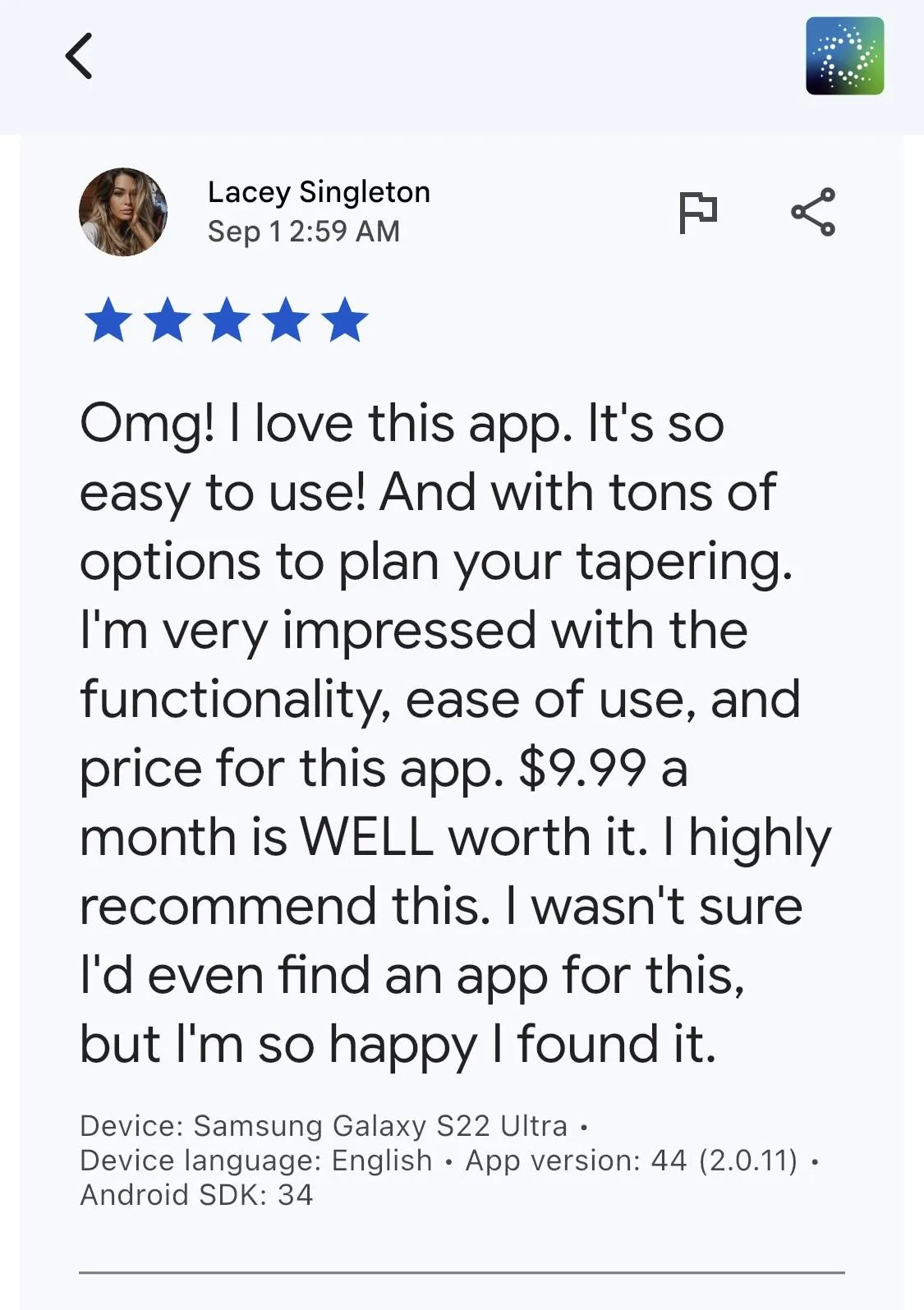
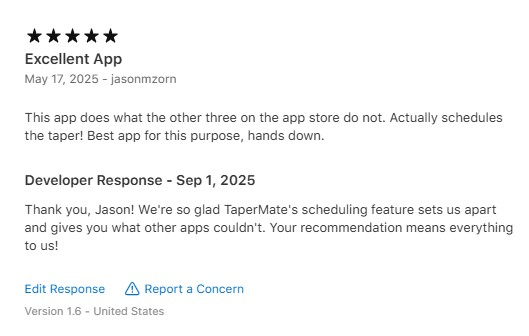
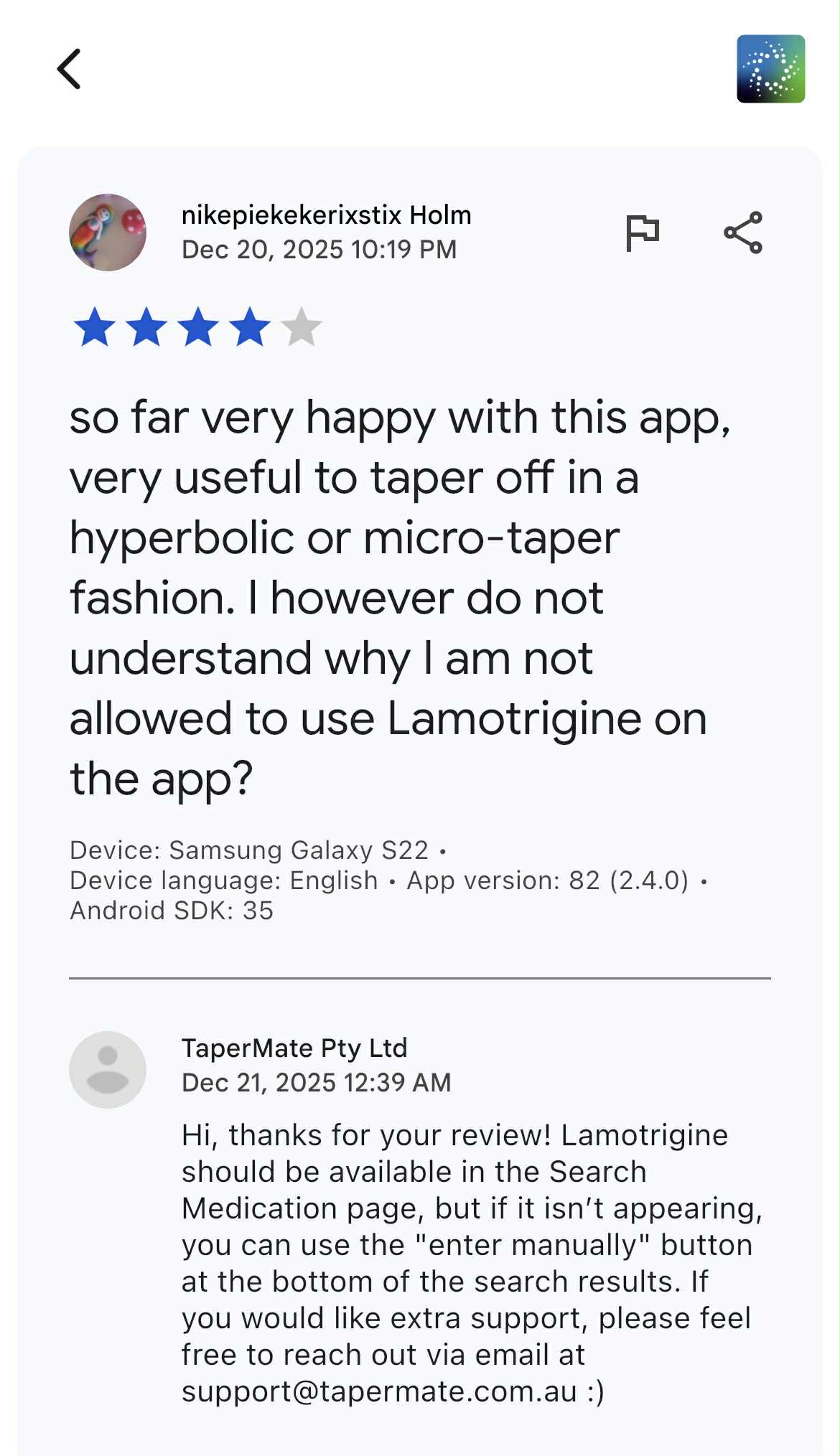
What others are saying
MEET THE FOUNDER & CEO
Hey, I'm Alicia
I'm a pharmacist from Canberra, Australia with a passion for helping people to safely stop medications they no longer want or need. I could see that antidepressant withdrawal was a huge problem affecting millions of people around the world and I wanted to help. So, I created the TaperMate App to give people the support they need to safely taper off their medications, to avoid (or at least minimise) withdrawal symptoms and experience life medication free.
Innovative Pharmacist of the Year 2024
Have personally helped countless people to safely taper off their medication in conjunction with their doctor
Have been a member of online peer support forums for medication tapering and withdrawal for years, have learned directly from people struggling with withdrawal and tapering

MEET THE FOUNDER & CEO
Hey, I'm Alicia
I'm a pharmacist from Canberra, Australia with a passion for helping people to safely stop medications they no longer want or need. I could see that antidepressant withdrawal was a huge problem affecting millions of people around the world and I wanted to help. So, I created the TaperMate App to give people the support they need to safely taper off their medications, to avoid (or at least minimise) withdrawal symptoms and experience life medication free.
Innovative Pharmacist of the Year 2024
Have personally helped countless people to safely taper off their medication in conjunction with their doctor
Have been a member of online peer support forums for medication tapering and withdrawal for years, have learned directly from people struggling with withdrawal and tapering